December 31, 2018: It has taken me six days to sit down to write a blog about spending Christmas in Bethlehem. And it will take more days to post it, I’m sure.
I call it my six-day war with words, trying to reconcile the range of emotions I experienced during my 72 hours in the holy city where Christianity was literally birthed.
When I first sat down to write a quick little travel blog about my trip, I thought it would be short and sweet. The birthplace of Jesus, right? A manger here, a Christmas tree there. Oh little town of Bethlehem, how still we see thee lie?
Well, if things were only that easy.
You’re not going to believe this, but my struggle with words has been this: Jesus or Banksy, Banksy or Jesus? Who has had a greater impact on Bethlehem, Prayer or Sprayer?
So to move this blog along, I decided to break it into two parts: Part 1, “Prayer,” which will cover my trip to Bethlehem through the eyes of a simple Christian pilgrim; then later, Part 2, “Sprayer,” to share my perspective on Banksy, my visit to a Palestinian refugee camp and, of course, my run-in with the ubiquitous wall.
PART 1: PRAYER
Oh Come Ye to Bethlehem
I’m doing the Christian Holy Land backwards.
When I first arrived in Jerusalem I made a bee-line to the Church of the Holy Sepulchre, the site of Jesus’ tomb and crucifixion — the “it” place for Christians in Jerusalem. Then I prayed the Stations of The Cross on the Via Dolorosa with about 30 brown-robed, sandal-wearing Franciscan priests, before visiting the room of the Last Supper. Later, I walked down the Mount of Olives to the Garden of Gethsemane where “Judas” became a bad name; and hiked up to the Monastery of the Temptation in Jericho where Jesus was approached by Satan after spending 40 days and nights in the desert (which I totally related to — the temptation part, not the hiking and camping).
Then came the little town of Bethlehem.
On December 23, I jumped on an Egged* bus in Jerusalem across from Damascus Gate, excited to visit a city I had read about, heard about and sung songs about since I was a baby wrapped in swaddling clothes (as I was born before the advent of Pampers).
Bethlehem is essentially a suburb of Jerusalem, about a 20-minute ride south of the Old City. But Bethlehem is also a Palestinian-controlled city in the West Bank — which meant I had to deal with that pesky wall.
I got off the bus at the last stop, Checkpoint 300. The 20-foot tall concrete barrier topped by rolls of barbed wire fencing, metal gates and armed guards in a gun tower made it very clear that this was my “last stop.” No real need to press the red button on the Egged.
At this point, I was on the Israeli side of the barrier, not yet in Bethlehem. So I still had hope there would be a big red and white “Welcome To Bethlehem!” sign on the other side, with a giant plastic candy cane archway to pass through, and a large nativity scene — maybe with real camels! I bet they really do it up right for Christmas, I thought to myself.
As it turned out, that would be a big “Nope.” Not even close.
Instead of walking under a candy cane arch, I spun through a cold metal turnstile and worked my way down a concrete corridor littered with trash. The corridor emptied me out into a yellow sea of taxi cabs.
No welcome signs, no candy cane arches, 
no baby Jesus…and not a camel in sight. Just concrete, barbed wire and a pack of about 30 Palestinian cab drivers clustered in groups outside their cars, smoking cigarettes and drinking Turkish coffee.
The cabs were jammed together in a cul-de-sac at the base of the separation wall, parked haphazardly like cars at the end of a demolition derby.
“Taxi! Taxi, mister? Hey, you need taxi?”
I was swarmed.
“No, shukran (thank you), I’m good,” I replied. I forced a smile and walked through the gauntlet of drivers. I knew from my Lonely Planet travel guide that Banksy’s Walled Off Hotel where I was staying was just a short walk away, so I hoofed it.
Away To The Manger
After checking in to the hotel, I went straight to Manger Square and the Church of the Nativity, the epicenter of all things Christmas in Bethlehem. The church was built on what reportedly is the exact spot where Jesus was born. Exact or not, it’s close enough, so I went with it.
To my relief, Manger Square was everything I expected it to be. No surprises. They even had the “I Love Bethlehem” sign I had envisioned when I first got off the bus!

(Though they cut it close. When I was walking to Manger Square on December 23, construction crews were still putting up the sign. This picture was taken on the 24th. What a difference a day makes! On the 23rd it only read, “I Love Beth.” I thought, wow, what a guy. He must really love Beth to make that kind of commitment to her, lucky girl.)
Christmas is Bethlehem’s Super Bowl. The atmosphere was electric!
Manger Square was decked out in neon wreaths and lights and a giant Christmas tree topped with what looked to me like a Macy’s department store star. A life-sized manger scene was set up on the performance stage, surrounded by a large sound system and speaker towers. It was as if Balthazar brought his DJ set to the birthday bash.


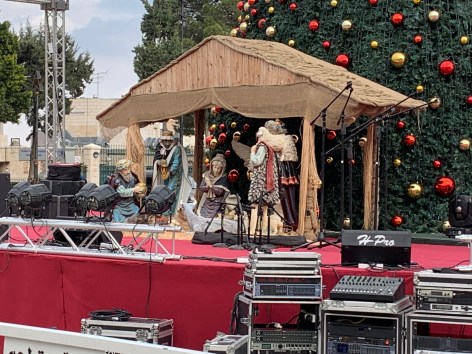
Merchants of all ages paced the square hawking their wares — everything from crucifixes to selfie-sticks. A group of Chinese pilgrims proudly waved their country’s flag (as if anyone really cared to see a state flag in such a universal place) and sang Christian hymns under the bell tower of the Church of the Nativity. A big screen TV was set up in the church courtyard to broadcast the sold-out Midnight Mass that was soon to be celebrated inside. Getting a seat for Midnight Mass was clearly the hardest ticket in town! You needed to know somebody, and I knew nobody.


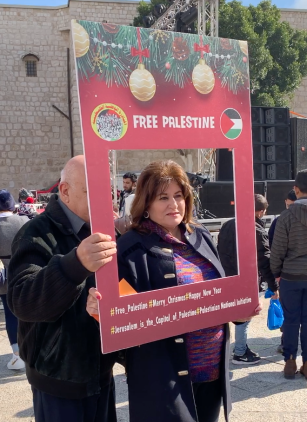
As with everything here, politics is never too far away, even on Christmas Eve. “Free Palestine” photo ops were available free to the masses. Speaking of photo ops, President Abbas, the Muslim leader of the Palestinian Authority, made a guest appearance to the church at 9:00pm. His entourage of security guards and parade of Mercedes Benz’s was quite impressive as it navigated its way, lights flashing in a “look at me” versus a “get out of my” kind of way, through Bethlehem’s narrow cobble-stoned streets.
The Church of The Nativity
The Church of the Nativity was commissioned in 327 AD by Constantine The Great and his mother, Helena. It was completed around the year 339. I earlier qualified the church as being built on the exact site of Jesus’ birth simply because over 300 years had passed between the birth of Jesus and the building of the church. That’s a long time. After 300 seconds I barely remember the spot where I left my jacket. But exact or not, the spirit of Christ is everywhere.
Inside the church is the grotto — the tiny cave in which Jesus was born —reportedly the oldest site continuously used for worship in all of Christianity. By the size of the crowds waiting in line to enter, that record looks to continue.


First, it took an hour and a half to get to the door of the grotto, passing a souvenir stand along the way for good measure. To enter the grotto, people are funneled down stone steps through a door so small you have to duck to get in.
Once in, four people at a time approach the small ornate altar, under which is the cave-like space where Jesus is said to have been born — the grotto — His crib. A silver star marks the spot of where He first lay. Worshipers kneel before the altar, reach into the grotto, touch the silver-star marker embedded in the ground and say a quick prayer.

The prayer itself is not only an expression of faith, but an exercise in concentration. With people literally breathing down your neck, all the pushing and shoving and click-click-clicking of cameras going on around you, you really have to block things out and concentrate to appreciate what lay before you. If you can do that, which I was able to do, it truly is a “wow” moment in life, both spiritually and historically.
But then it’s over.
When your 10-seconds of solace are up, the ushers say “Next” and shepherd you out the side door — though not before you get a chance to snap a quick selfie if you’re so inclined, which most people were. 
Speaking of shepherds, here’s a side-bar for you:
Shepherd’s Field is a nearby attraction that people,
uh, flock to while in Bethlehem. Located just a
half-mile east of Manger Square, it is worth a quick
stop to see where the angel appeared to the
shepherds and said, “Hey guys, over there,” pointing
up the hill.
On Christmas day I attended mass at St. Catherine’s, the Roman Catholic Church adjacent to the Church of the Nativity. That, too, was a “wow” moment, especially when the choir began the celebration by singing “Oh Come All Ye Faithful” in Latin. When the verse, “Oh come ye, oh come ye to Bethlehem” was sung, the word “Bethlehem” hung in the air like a heavenly fog. It gave me chills thinking that I was actually there, in Bethlehem, on this particular day.

The mass was said in Latin. For the sermon, however, the officiant spoke in English before a second priest volley’d the officiant’s words back in Arabic. The church was packed with pilgrims (a.k.a. tourists), but the priest explained at the outset that this mass was for the local members of this parish, the majority of whom were Palestinian Catholics.
Palestinian Catholics? Just one more thing that turned my head.
As commercialized and crowded as Christmas in Bethlehem was, it truly was a rich spiritual experience for me as a Christian. No doubt about it, Christmas in Bethlehem is special.
But then again, so was the tomb of Christ, the site of His crucifixion, His way of the cross, the garden of betrayal, the room of the Last Supper, the rock of temptation…
You get the idea. Each experience in the Holy Land in and of itself is worthy of being the greatest story I ever get to tell.
PalRael
*Jerusalem has two public bus services, one Israeli and one Arab. “Egged” is the Israeli service. While the Arab bus station was a few blocks closer to me, I chose to use the Israeli bus line knowing that I had to go through an Israeli checkpoint to get into Bethlehem, thinking that they would like me more (hassle me less) if I got off an Israeli bus versus an Arab bus. Warranted or not, these are the day-to-day considerations one makes in Israel/Palestine.
Coming soon, Part 2: Sprayer (The Bethlehem of Banksy)

 Solo in the Holy Land