
I came to the Holy Land praying for a growth spurt.
Not a physical one, hoping to become six-foot-six. Nor a spiritual one, as a trip to the Holy Land might suggest.
Rather, I am praying for a growth spurt in cultural awareness and understanding, creativity, imagination and character. A growth spurt of person.
I read an inspirational quote on personal development that said: “First, choose the options that thrill you. Then, choose the options that also teach you. And from these, choose the option that scares you most. Butterflies in your stomach are good.”
So here I am in Israel (Palestine, the West Bank, the Holy Land — take your pick of names) looking to grow over the next eight weeks while advising a non-profit publication whose mission is to build peace between Palestine and Israel by providing its readers balanced perspectives on both sides of the argument.
And, yes, I am scared. Scared, and a bit paranoid.
The butterflies flew and paranoia grew well before take-off.
The gauntlet of questions El Al’s (the Israeli airline) security team hit me with at check-in got my trip off to a sweaty start. Where are you going in Israel? How long are you staying? Why so long a time for such a small country? Do you know anybody here? Where are you staying? What do you do for work? How can you be away so long? Can I see an example of the work you do? If you’re a tourist, why didn’t you come with a group? Oh, your friend from Jordan suggested Petra. Did he ask you to bring anything with you? Who packed your bags? Do you live alone? Where else have you traveled? Why did you choose Israel of all places to visit?
I have never felt so unwelcome in a place where I had yet arrive.
That last question, “Why Israel,” I knew was a loaded one, so I deflected it by flattering the security guard’s homeland. It must have worked as I eventually passed through (though not without a special requirement to hand-check my bag).

Why did I choose Israel instead of, let’s say, Istanbul to get uncomfortable? It was a loaded question because I knew that if I answered it truthfully they would not let me board the plane.
The true answer is this:
I had never heard the word “Nakba” until about 10 months ago.
With a Bachelors degree in History, and life-long (though casual) interest in foreign affairs, I had heard about the 1947 U.N. Mandate to create Israel, the Six Day War, the raid on Entebbe, the two Intifadas, Yasser Arafat and the PLO, Gaza, Hamas, Abbas, The West Bank and the Green Line. History 101 stuff.
But not the Nakba. Not the “Catastrophe.”
Not until I met Amal, who was born and raised in Amman, Jordan, before moving to the U.S. at age 21 and becoming an American citizen, did I ever hear the word “Nakba.”
Amal told me about the Nakba and how Americans only heard the Israeli version of events that transpired in 1948 when Israel became an official state and reclaimed “their” land by displacing over 700,000 Palestinians from their land and homes with no good place to go and no right to return.
I can see how one people’s independence is another people’s catastrophe.
Curious to learn more, and coincidentally timed with the 100-year anniversary of the Balfour Declaration which gave Zionism a real turbo-charge, I picked up a newly published history book, “Enemies and Neighbors: Arabs and Jews in Palestine and Israel, 1917 – 2017,” by British journalist Ian Black.
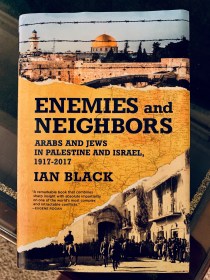
In it, Black guides the reader through a chronological, fact-based, history of the relationship between Arabs and Jews in the land of Palestine/Israel starting with the launch of the Zionist movement in 1897. This book changed the way I looked at Palestine, Palestinians, Israel, Jews, Zionists and the Arab states that surround them. It changed the way I view Palestine and Palestinians for the better; of Israel, Zionism and the Arab states, well, not so much.
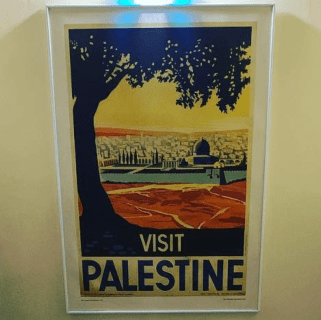
Talk about ironic: this iconic poster
was designed in 1936 by Franz Krausz
on commission from the Tourist
Development Association of Palestine to encourage Jews to visit and move to the
area then known as Mandatory Palestine.
The book inspired me to visit Palestine/Israel to get a first-hand taste of, to the degree possible, the plight of the Palestinians and the perspective of the Israelis — my personal growth spurt. I am doing my best to come in with eyes-wide-open, and am fully aware of my naiveté on this topic.
The fundamental issue is this: two people, one land. And the two people despise each other.
Israelis (some, not all) consider Palestinians to be dirty terrorists. Palestinians (all) say they have been occupied and abused by Israel for decades and want the right to return to land (and in many cases, specific homes) that was once theirs.
Is a two-state solution possible? Is co-existence possible? Is the status quo tenable? Can personal perceptions be changed?
Answers to these questions won’t come within the next eight weeks, I know (see “naiveté” above). But it is exciting to be in the middle of the action in Jerusalem, working with, and discussing such heady issues with people who live them, and passionately try to solve them, every day.
So, let’s see where this story goes. Let’s see where this journey takes us. Who knows? Maybe we’ll find a ray of hope for peace in the Middle East!
(If not, at least there is still hope you will learn where to get the best falafel sandwich in East Jerusalem! I think I found that place today, in fact. And it was only 8 shekels! But you’ll have to keep reading my blog or follow me on Instagram @PALRAEL to find out where.)
Peace!
PALRAEL

 Solo in the Holy Land
Looking forward to hearing from someone with no agenda.
LikeLike
Thank you, Theresa. Even people with agendas have something to learn about this place. Every day something new and mind-opening happens!
LikeLike